
The Llama Lodge
Guest Handbook
Croeso!
Welcome to the Llama Lodge at Glanrhydwilym farm - home of the Llama Sanctuary registered charity, and our Pembrokeshire Llama Trekking experience. Why not book in with us to take your very own llama for a walk during your stay?
When leaving the lodge for any period of time, please check to ensure that there are no cats or other animals left inside.
In the interests of sustainability, please ensure the lights are off every time you leave the lodge, overnight etc. Electricity is increasingly expensive and we prefer our funds to be spent on rescuing llamas, not wasted electricity - thank you!
There is room to turn your car around directly outside the lodge (i.e. 3/5 point turn). Please do not use the grass in front of the house as several people have managed to get themselves stuck here over the years.
Glanrhydwilym
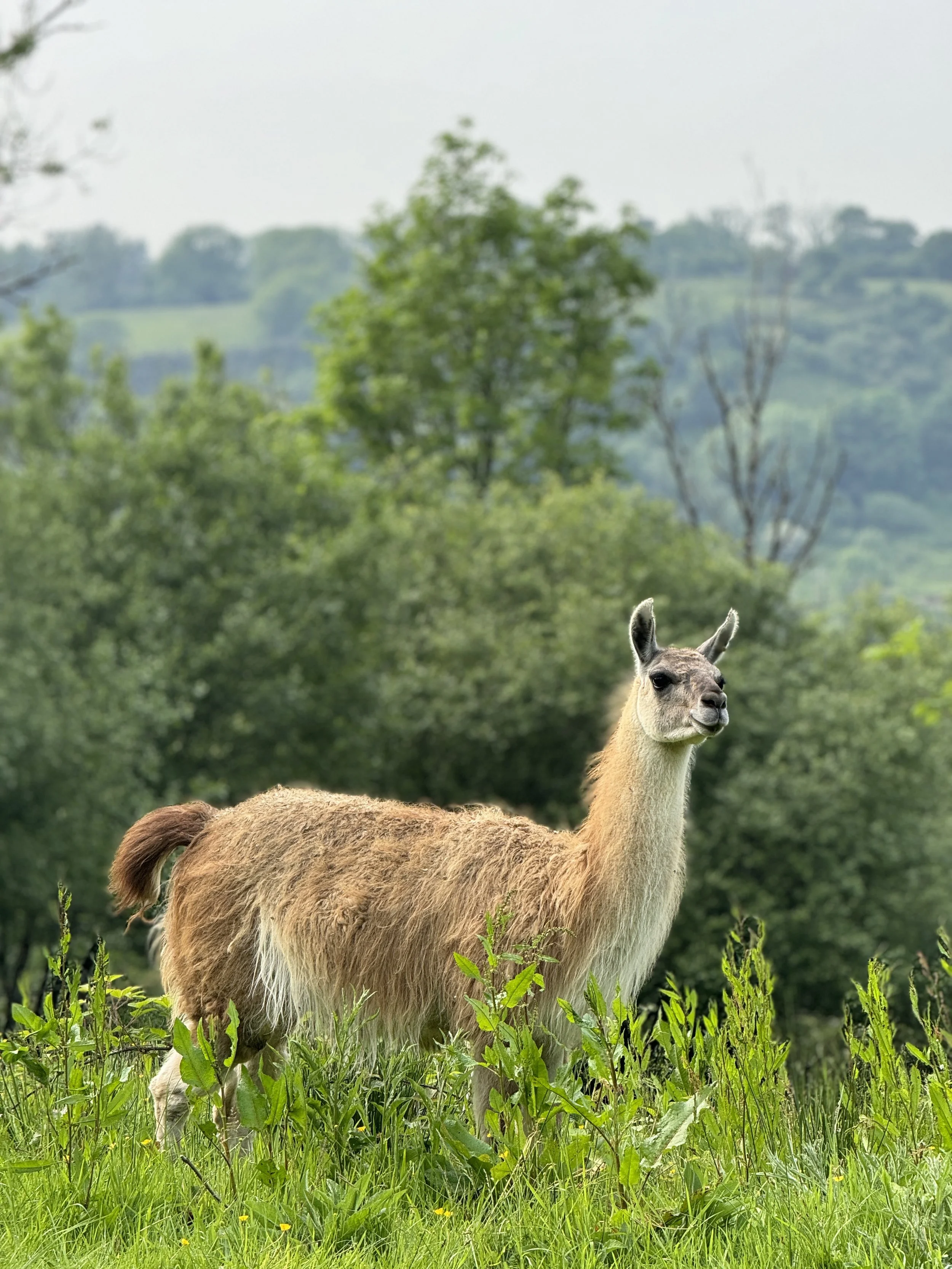
Glanrhydwilym is home to several talking apes: Matt, Aleks, and Matt’s son Macsen. Also in residence are our eighteen llamas: Ieuan (Welsh for ‘John’, pronounced ‘Yay-an’), Teilo (‘Tie-lo), Zazu, Albie, Max, Myrddin (‘Merr-thin’ - Welsh for Merlin), Hendrix, Thelonious, Dylan, Noah, Gordon, Bob, Jojo, Ethelred, Bojack, Untitled Llama #1 (a recent rescue without a name yet), plus our rescued girls, Pandora and Zara. More information on each llama and their personalities can be found on our websites www.llamas.wales and www.llamasanctuary.org
In addition to llamas, you will no doubt have noticed the many birds - the customer liaison turkey Sir Patrick Moore and 10ish chickens. Also living here are our three Toulouse geese Chompy, Sussy and Squirty, plus Rodney the white rescue gander. Fintan our livestock guardian dog will have probably welcomed you during your arrival, along with his sidekick Moshka the Old English Sheepdog / Bernese Mountain dog cross. Four (formerly feral) cats lurk on the property, and become more active in the evenings and at night once the birds have gone to bed.
In the warmer months, a family of bats descend from the roof of the main house and soar across the valley looking for food. Also in residence during the summer are a family of beautiful barn swallows who entertain us with their acrobatic swoops and fast turns across the farm.
The Llama Lodge
The Llama Lodge is a wood cabin constructed in 2007. Inside, you will find the main living area, with kitchen, dining area, and log burner. There is a fridge, sink, toaster and kettle. The bedroom is located at the back of the main room, whilst the bathroom with sink, shower and toilet is on your right as you enter the Lodge.
The Lodge shows the scars of many battles with the elements over the years - we are currently awaiting a carpenter to come out to replace all of the windows and doors, which as you can see are nearing the end of their lifespan so please be gentle! There is also some historical weather damage in some of the corners - we treated all of these issues when we first took over the lodge so they are not ‘current’, but have left the interior unpainted and imperfect, which means it can still tell its story.
Arrivals & Departures
Check in time at the Llama Lodge is anytime from 4pm onwards.
On the day you are due to depart, we ask that all guests vacate by 12 midday so that we can prepare the Lodge for the next guests arriving later in the afternoon. You can either drop the keys off to us in the main house, or leave them hanging up in the lodge if you’re in a rush - either is fine. Please ensure all washing up is done before you leave, and that all cups, plates, cutlery etc is left in the same state you would wish to find it.
Additional Costs
Extra logs - £10 for a crate
Eggs - £2 for 6 (can usually be purchased from the main gate at the top of the drive)
Llama walks - £45 per person (2 hour walk)
Llama merchandise can be bought online from the shop at www.llamasanctuary.org - all profits go towards our llama rehoming charity.
Parking
There is room for several vehicles directly in front of the cabin - please use this space to park / turnaround your car. Please do not leave your vehicle further up the yard / in front of the main house, as this is used as a turning circle by all other residents. If there are other vehicles blocking you from parking or leaving, please highlight this to us and we will resolve the situation asap.
Wifi
If you have any difficulties connecting to the WIFI, please let us know and we will be happy to help.
Network: LLAMA.NET
Password: turkey123
Phone Reception
There is no mobile reception on this side of the valley. The fastest way to gain a signal is to head back up the hill. Good coverage can be found from the laybys once you reach flat ground. If you have a smart phone, don’t forget that you will probably be able to use the wifi calling feature on your phone (or video calls) from inside the lodge.
Emergencies / location
In an emergency call 999. There is no mobile reception here, but most modern mobiles can connect to the lodge wifi (details above) to make calls. If you are struggling to connect please knock the door of the main house and we will assist.
Your address is:
Glanrhydwilym Farm
Rhydwilym
Llandissilio
Clunderwen
SA667QH
You can provide emergency services with your ‘what3words’ location, which will help them to pinpoint your location to a few metres. The what3words location for the llama lodge is: hologram.froth.release
You should also provide the what3words to the entrance to the farm (i.e. the top main gate) as many sat navs will take people past the entrance and down the hill. The what3words for the main gate is approximately: momentous.premises.special
Once you have contacted emergency services please also contact us / knock the door on the main house to make us aware of the emergency so that we can try to assist.
Smoking & Vaping
Please do not smoke or vape in the lodge. Guests are more than welcome to smoke / vape outside (away from animals and other humans), but please do not leave cigarette ends on the ground or dispose of them in nearby hedges due to fire risk - ideally these should be placed into a used bottle or similar.
Drones
Please do not fly drones on or near the farm without consulting us first - the only buzzing we like to hear is from the bees! We appreciate that drones are quite fun and the footage can be incredible, however they can also be quite intrusive for other farm occupants. Our neighbours will certainly not appreciate them. Some of the llamas have been known to jump fences to get away from drones in the past, which can be dangerous for both them and the public. And our dog will 100% spend every second that the drone is in the air barking at it (he most likely thinks it is a bird of prey / threat to his chickens). Even when the drone has landed, he has been known to bark afterwards for long periods of time which is no fun for anybody. If you would like to fly your drone nearby, we would recommend walking to the chapel car park further down the valley, where you should be able to operate it safely without impacting local livestock, and get some spectacular footage of the river and surrounding areas.
The Log Burner
We supply a selection of wood for the log burner, in addition to kindling and paper. If you run out of the initial supply, additional crates can be bought from us for £10 each, or there are several nearby garages that also stock firewood. Please do not burn coal, cardboard, plastic(!), your rubbish, or anything other than wood and paper in the fire. In addition to being detrimental to the atmosphere, most non-wood materials can also damage the chimney and / or cause chimney fires. Please don’t burn the Coast to Coast magazines left in the porch - these make very poor fire starters, leave a lot of ash, and are needed for subsequent guests. If you run out of newspaper to start fires with and need more, just let us know and we will supply more.
To light the wood burner start by placing some of the supplied crumpled paper into the stove. Do not crumble the paper too much as it will burn more effectively if left slightly open. Add sticks on top. Be sure to leave plenty of space in the chamber for air - your fire will not burn very well if you completely fill the stove with paper and logs.
There is a flue just above the front door - ensure this is open (move to the left) prior to lighting to ensure maximum air flow within the chamber. There is a secondary flue at the bottom of the door - make sure this is open (move to left) too. Light the paper and close the door - but not fully - leave slightly ajar to allow air to enter.
Slowly add sticks as the fire burns, building up to small logs. Be sure not to smother the fire with logs - place new fuel to the sides of the main fire so that it has a chance to catch alight.
Finally add the larger logs, and top up occasionally as required. Once the fire is established the door can be fully closed.
For maximum heat, leave both flues open. This will make the wood burn fast and hottest. To slow the burn (i.e. when going to bed and you want to maximise the length of time that the fire burns for; or if the temperature is too hot) then close both flues. The fire will still burn but at a slower, cooler pace - meaning logs in the stove will last for a longer time period.
Emptying The Fire
Generally guests staying two or three nights will not need to empty the fire, as the ash pan will hold several night’s worth of ash. However if you are staying for a longer time period or see the ash pan getting too full, this can be emptied on the ground at the side of the Lodge (turn right as you exit the Lodge from the main door).
Please ensure the pan is cool before emptying, as fires have been started by people emptying ash that has not cooled.
Ensure you empty the pan sufficiently far away from the Lodge (a few metres should do the trick), and evidently do not empty the ash near or on thick foliage in case it gets set alight. Also beware of emptying when it is windy!
Oven & Hob
There is an electric oven and hob in the Llama Lodge, and the instructions can be found in the drawer next to the fridge. There is also a microwave.
Rubbish & Recycling
We aim for zero waste at Glanrhydwilym, but understand that when on holiday it is sometimes unavoidable to generate rubbish. The copper bin by the back door is for general waste. There is a green food bin on the shelf of the porch (no bag required, food can go straight in). If you are staying for an extended period and the food bin is becoming full, let us know and we can empty this for you.
There are three recycling bins in the porch under the shelf: one for cardboard and paper, one for glass, and one for tins, cans, cooking foil, plastics etc. If you are unsure about recycling anything, please leave it loose on the porch shelf and we will recycle this after guests have departed. Please do not burn any rubbish, including cardboard (as this generates excessive amounts of ash).
Electrics
The Llama Lodge is connected to mains electricity. However, there is a limit on how many electrical appliances can be plugged in at any one time. Phone chargers, hair dryers and other small appliances should be fine, but please do not use any high power devices, such as electrical heaters, as these will trip the power supply to both the lodge and the main house. If the power trips in the lodge, it can be turned back on by flipping the circular dial on the right of the electrical box above the microwave.
Additional sleeping arrangements
We can supply additional bedding for the futon if your party requires extra sleeping space. Guests should have advised us prior to arrival if the futon is required as this generates additional linen and cleaning costs. We can also provide a travel cot, although guests will need to supply their own bedding.
Outside Communal Areas
Guests have use of the Lodge, the llama area to the east (can be viewed from the bathroom window - watch out for llama poo!), and the areas on each side of the cabin. Several seated areas can be found around the lodge for you to enjoy the views.
Other parts of the land are generally off limits so please check with us first, for your own safety. We are a working farm and there are many dangers for those unfamiliar with the layout, particularly children. If you are on foot, the nearest exit off the property is opposite the main house - there is a small side gate you can go through which will take you out on to the public road (watch out for traffic as you step on to the hill).
There are many nice walks and public footpaths nearby and across the valley - the nearest of which can be found opposite the main gate (near the yellow grit box). This can be an idilic walk, although be warned in winter it can be very muddy, and in summer at times can be overgrown in parts.
There are also numerous nice walks further down the valley - go down the hill and follow the road down past a few houses and a graveyard to find the Cleddau Ddu - one of the main rivers in Pembrokeshire. There are several nice walks in the vicinity of the river.
***Security Warning***
One of the pleasures of being in the countryside is leaving the front door open and letting the fresh air and nature in. We recommend this approach whilst staying at the Llama Lodge, but feel it is our duty to inform guests that should they engage in such activity, they will undoubtedly be visited by our turkeys and chickens, who will likely proceed to wreak havoc to anything they can get their beaks on (please keep them off the furniture). A visit from one or more cats is also probable, and you may find them curled up on a chair or in the bed (they will also come in through open windows). Open doors may also initiate a goose or llama visit! Our Old English Sheepdog / Bernese Mountain dog cross - Moshka - has been known to take advantage of an open door to happily get into bed with guests.
If you leave the door open on a windy day, please ensure that you prop the door open by placing a rock, log or similar at the base, so it does not blow in the wind and become damaged.
Llama Treks
Please let us know in advance if you wish to book a llama trek, and we can advise on availability. Treks take approximately 2 hours and cover roughly 3 miles. We usually need to know at least 24 hours in advance. Treks cost £45 per person.
If you are booked in for a llama trek, we will meet you outside the Llama Lodge at the scheduled start time, and provide a brief talk on handling and safety.
Treks can also be booked on our website www.llamas.wales
Water Temperature
The Llama Lodge utilises a large electrical water heater and storage unit, situated at the top of the bedroom cupboard. This continuously heats a steady supply of water ready to be used throughout the cabin and is large enough to meet normal water usage.
Please note that if the hot water is used for any length of time i.e. a shower is taken, or the hot tap is left running in the kitchen, then you may find that the water temperature drops for a period of time. This is because the warm water supply in the electrical heater has been drained and it must reheat a fresh supply of cold water to replenish the water that has been used.
Therefore we recommend guests be mindful of how much warm water they are using at all times, especially if you are staying as part of a group. If guests are planning to shower in close succession, they may wish to keep the shower time shorter to ensure that there is enough warm water for the next person to enjoy!
Extra towels
In order to be as sustainable as possible, we recommend towels in the Lodge are reused as much as possible. If you are staying for longer than a few nights and would appreciate a fresh set of towels, just let us know.
Hair Dryer
A hair dryer is available to borrow upon request.
The llamas
We currently have sixteen llamas living with us. You will notice that they are very nosy and will curiously approach you to see what you are up to. There is a great deal of llama information to be found on our websites www.llamas.wales and www.llamasanctuary.org including descriptions of each llama and their personalities.
The Dogs
Fintan is our white livestock guardian dog. His breed - the Maremma - has a very low prey drive, meaning he is perfect to be around poultry without chasing them, whilst protecting them from foxes, hawks, and other predators.
Fintan is a working dog - please do not disturb him. Do not put arms / body through, on, or near his fence line. Do not enter his areas of the farm without an escort. Supervise children at all times.
Maremmas are bred to be independent thinkers - traditionally used to guard livestock without any form of human supervision. This means Fintan is very strong willed and will not stop doing what he is doing just because someone tells him to stop. Maremmas are very different to domestic dogs - they are their own boss and will not necessarily listen to commands. Issuing a ‘sit’ command generally has a 50/50 success rate. They have zero recall.
The first line of defence for a livestock guardian dog is their bark - they use this to warn predators of their presence and to stay away. They are very intuitive dogs - they will quite often have spotted a potential threat several fields away, or across the other side of the valley, or picked up a predator scent some miles across the valley. Whilst it may sometimes appear that Fintan is barking at nothing - he has picked up on a threat that we will most likely never know about, because he is doing his job and keeping it away from the farm.
Consequently there may be times when there is a prolonged period of barking during the daytime. We constantly monitor this and if it gets excessive we will consider bringing the dog inside temporarily so that guests are not continuously bombarded by barking. Evidently, this has to be weighed up against the potential predator risk. Most of the time we are confident that we can achieve a happy compromise. If however you feel the barking is becoming too onerous, do let us know and we will see what can be done. Fintan sleeps in the house at night, since all vulnerable livestock are locked up. This keeps the night time environment blessedly peaceful!
Fintan was born on Christmas Day, 2020. His name means ‘white fire’ in Irish Gaelic.
Moshka is an Old English Sheepdog / Bernese Mountain dog cross. She is in charge of llama treks and gets very upset if she is left behind if we go out with customers. She likes to lead the treks and constantly patrols the line to make sure no one gets left behind. We don’t tend to let Moshka out near the lodge often as she likes to chase chickens! If you do see her out though, make sure your car doors are closed or she will be inside - she is obsessed with sleeping in cars.
Moshka was born 7th March, 2024. Her name means ‘midge’ or ‘gnat’ in Russian.
Turkey
We currently have a single turkey - Sir Patrick Moore was hatched in Summer 2022 upon request of our son who wanted pet turkeys for his sixth birthday. You will notice that he is very nosey and demanding - he loves people and getting attention. Sir Patrick is a gentle giant and is generally content to just follow you around all day. Sir Patrick lost his brother Elvis to illness in December 2026.
Please keep an eye on children at all times around Patrick and do not let them chase him, as this will inevitably result in injury to either the bird or the children!
Chickens
We have approximately fourteen chickens on site. The exact number fluctuates constantly - new chickens are born each year, and several pass away through a combination of age, illness, and in the past, predators.
We keep chickens predominately because we like watching their antics and interactions (despite the fact that they have destroyed our garden). The eggs are evidently much appreciated too, although with the price of chicken food in recent years, they are not exactly a cost effective option.
Some of the breeds you will see outside the Lodge include: Bluebell (grey-blue with black-grey head), Ayam Cemani (completely black), Hylines (ginger-red), Leghorns (white), several small bantam breeds, and numerous rescued hybrids.
We also have our own Glanrhydwilym breed that we have developed on site in previous years - our breeding focus has predominantly been on hatching chickens that lay blue eggs, so we have many chickens with Araucana genes. Most of these tend to be black or near black in colour.
Our jet black rooster is the rare Ayam Cemani breed and his name is Johnny Cash.
The hens names are: Blue (Glanrhydwilym black, blue eggs), Bamboo (Glanrhydwilym black, blue eggs), Socks (black hybrid, brown eggs), Catalina (black rescue bantam, small pale brown eggs), Chungus (Glanrhydwilym ginger / black cross, brown eggs), June Carter Cash (Ayem Cemani, brown eggs), Fishfood (bluebell, brown eggs), Knickers (leghorn, white eggs), Bookkeeper (leghorn, white eggs), Bin (hyline, dark brown eggs), Yulia (bluebell, brown eggs), Val (black hybrid, green eggs), Betsy (white - Light Sussex, light brown eggs), and Ffion (white Araucana hybrid, blue eggs).
Please keep an eye on children at all times around the chickens and do not let them chase them, as this will inevitably result in injury to either the birds or the children!
Geese
Geese predominantly eat grass, and are so good at keeping the lawn in shape that we only have to mow the grass a few times a year. They are also our alarm system and security guards. There are 6 geese on site - Rodney the white gander (rescued from a scrap yard in South Wales - his partner had died and he spent all day staring at his reflection in a mirror), 4 Toulouse (grey) geese - this breed hails from France and is one of the largest breeds of goose in the world. 3 are young and mischievous and 1 is very old (born 2016). Her name is Gustava - please be patient with her as she can be quite slow and she is getting very delicate.
In 2021 Gustava lost her sister and best friend - Gertrude. We hatched three replacement Toulouse geese to keep her company - Sussy, Squirty, and Chompy - all excellent at causing trouble.
We also have a very sweet rescue Canada goose that a friend’s dog caught when it was a chick. We have raised her with the rest of the goslings and they now have a strong bond. Her name is Teddy. Sometimes she flies around the farm but most of the time is content to stay on the ground. In the spring other Canada geese fly over and call to her, but to date she has never been interested in going with them.
Geese are generally all noise and little bite, but if they are harassing you too much during your stay let us know and we will put them out of the way in the garden.
Please keep an eye on children at all times around the geese and do not let them chase them, as this will inevitably result in injury to either the birds or the children!
Cats
All the cats at Glanrhydwilym are formerly feral and came free with the house (i.e. were already living on the land when we moved in). There are four siblings: Hieronymus (aka Ronny - ginger), Predith (aka Pwt - ginger), Ember (little fat ginger) and Pangur (white/apricot ginger). They were joined by the black cat Jeremiah Johnson a few years later. Most of our cats are very needy and will happily let themselves into the lodge. Please kick them out if they overstay their welcome, and do not leave them locked in unattended, as nature will undoubtedly take its course and you will need to clean up the resulting accident!
Feeding the animals
Cats - you are welcome to feed the cats cat food (wet or dry) or meat (but please ensure no bones).
Chickens / turkeys / geese - fruit and some veg are appreciated: apples, strawberries, pears, bananas etc. They also enjoy eggs (raw or cooked). Please NO BREAD as this can get stuck in their throat and is very unhealthy for them.
Llamas - the llamas are generally not interested in taking food from people and we do not encourage this as it can lead to behavioural issues. You can try holding some hay for them, and some will happily take it from human hands (but watch your fingers!). Please supervise children at all times and use common sense.
Dogs - please do not feed the dogs, as they are on a specialised diet and feeding them anything extra may cause health issues.
Farm Rules
We are a working farm and children should be supervised at all times.
Please do not fly drones on or near the farm (see section on drones for fuller explanation).
Please do not enter the chicken house - this can stress the hens and affect their egg laying routine.
The chicken door is closed at certain times to protect them from predators, so please never open the door if it is closed.
Please do not help yourself to (or allow children to take) chicken eggs from the chicken house. Many of these are fertilised eggs that the hens are nesting on. Removing these will stress the hens and impact future egg production. Eggs are usually available to buy from the house or main gate.
Please do not leave food or bags of rubbish outside the lodge as this will attract rats, chickens, geese, foxes, dogs etc who will split the bag and drag the contents all over the yard. We do not wish to attract rats and foxes for obvious reasons, but chances are the chickens will get to any food first anyway - usually within a few minutes, so rubbish should not be left outside even for the shortest periods of time. Food can be placed in the green compost bin. If you have any other rubbish you would like to dispose of please let us know and we can ensure this is done in a manner that does not attract undesirable wildlife or pollute the area by bags being split open by animals.
Please don’t burn incense or generate any form of smoke / strong smell inside the lodge. Whilst the smell may be to your liking, it is not necessarily to ours or the guests coming in after you!
Children
Please supervise children at all times.
Please keep children away from the main house windows if the dogs are barking. If there is barking - they are too close (unless you want to pay for a new window!)
Please be considerate to other farm residents who may be asleep at different times to you and your children.
Please do not allow children to climb / hang off gates or climb up fences - this causes damage to the hinges / weakens joins. We are a charity and spend a considerable sum of money every year maintaining fences and gates so your cooperation in this matter would be extremely appreciated.
Please do not allow children to wander too far from the lodge - this is not a child activity centre - it is somewhere to stay to relax in nature. If they need to burn off some steam, there are beautiful walks down through the valley (there is a side gate opposite the main house you can exit out of). In particular, children love playing down in the river next to the chapel (use common sense - do not allow children near / in the river if the water level is high or fast flowing).
Nature
‘If you want to live in nature, you must learn to live with nature’
The Llama Lodge is often subject to visits from a myriad of natural visitors, including spiders, woodlice, slugs, bats, swallows, and all sorts of other sniffers and creepers. We tend to allow spiders to live in the lodge - they are good at keeping the flies down after all. Consequently you may find cobwebs inside during your stay in all of the nooks and crannies. The lodge is made of wood, and being a natural material it can bend and crack as part of its innate properties, which allows holes to form and visitors to enter. We would ask guests who are unwilling to share to gently escort any visitors back outside (using newspaper / cup or glass etc) - preferably somewhere where the chickens will not immediately eat them!
You will also undoubtedly notice the amount of animal waste outside the lodge, so please mind your step! Llama, chicken, turkey and goose waste makes excellent fertiliser - particularly llama poo which can be applied directly onto crops and doesn’t need to wait like other fertilisers to break down over a period of time. This may appear grotesque to humans who are used to living encased in concrete, but to the rest of the world it is very normal and has always been seen as a valuable resource over the course of human civilisation. We clear any llama waste periodically from around the lodge (usually after each guest leaves), so that it is a clean environment for the next arrival.
The Valley
The Llama Lodge is situated at Glanrhydwilym (‘the banks of Gwilym’s ford’) in the wooded valley of Rhydwilym. Popular for years with West Walian bohemians, the valley remains unknown to tourists and even to many Pembrokeshire residents! Footpaths and nature trails dart across once farmed soil, now returned to nature. Buzzards and red kites circle above. Through the middle snakes Y Cleddau Ddu (Cleth-eye Thee - ‘the Black Sword’) - one of Pembrokeshire’s main rivers, which joins its sister the White Cleddau further south at Aberdaucleddau (‘mouth of the two Cleddaus’).
There are no immediate amenities in the valley - the nearest small shops that sell food are approximately ten minutes drive away in Efailwen (Spar / post office) and Clunderwen (newsagent / pharmacist). Larger shops can be found in the nearby town of Narberth, which has an excellent selection of food shops and restaurants.
Valley History
Rhydwilym (and specifically the venerable chapel within) is the subject of the Llandysilio bard Ernest Llwyd Williams’ book Rhamant Rhydwilym (in English: the Romance of Rhydwilym). Capel Rhydwilym is the oldest active baptist chapel in the world and has historically strong links with the land we tend, Glanrhydwilym.
The chapel was founded by rebel minister William Jones, purportedly a prisoner at Carmarthen jail for preaching the gospel. It was here that he was allegedly converted to Baptism by inmates. Once free, his clandestine group set about establishing a foothold for Baptism in West Wales, despite the threat of persecution from harsh penal laws and local opposition from Independents and Quakers.
‘Jones and his people were deeply expert in all the apparatus of conscientious resistance: secret meetings, stealthy movements across country, marriages before elders without clerical authority, arranging burying-places for the members, and refusing to disclose their clandestine retreat...’
‘The gospel preached and practised by William Jones was not easy and attractive, but austere and uncompromising: baptising in winter, baptising old women...’
In these circumstances, it would seem a considerable achievement to establish such a remote centre for worship - literally in the middle of nowhere - with presumably no good roads on which to travel.
Riding on horseback or on foot for miles, for hours... Down steep valley sides and potentially through dense woods and thickets. All in secret, by people so uncompromisingly dedicated to a cause despite the potential implications and geographic hardship.
Words that come to mind to describe such people: stubborn, persistent, insubordinate, puritanical, mad. Words that could quite reasonably still be applied to the current population of the valley.
Issues / Problems
Please flag any issues or problems to us as soon as possible so that we can resolve or mitigate them for you. We can’t do anything about it once you have departed!
Please let us know if you need anything - we are just over the other side of the yard and are generally up until around midnight. Alternatively, you can send us an email / message and we will be with you as soon as we see it. In an emergency please knock the front door or call 07403 215818.
Thank you so much for choosing to stay in The Llama Lodge and we hope that you enjoy your stay with us.
Matt, Aleks, Macsen, and the llamas xxx
Places to go and things to see in Pembrokeshire
Pembrokeshire, tucked away in South West Wales, is a remote but beautiful corner of Wales, with spectacular coastlines on three sides and gorgeous countryside.
Top recommendations by the llamas:
A llama trek at Pembrokeshire Llamas!
Skomer Island or boat tour (puffins!)
The Preseli Hills - part of Pembrokeshire’s national park. Similar to the Brecon Beacons, but friendlier and more intimate. This is where the stones from Stonehenge originally come from.
Beaches:
West Coast:
Barafundle Beach - often voted in ‘world’s best beaches’ guides. Park at the National Trust car park at Stackpole Quay, and walk along the coastal path for about ten minutes to get to the beach.
Newgale - an extremely large beach, that takes around an hour to walk from side to side with varied scenery.
Druidstone Haven - secluded beach with small waterfall.
South Coast:
Broadhaven South beach - via Stackpole Lilyponds.
Tenby - three commercial ‘walk on’ beaches, popular with tourists, plenty of shops nearby in the town.
Freshwater West - a bit of a drive but worth it for any keen surfers. A long, powerful beach where the raw elements of wind and waves are hard to ignore.
North Coast:
Blue Lagoon - an old flooded quarry, popular with watersports enthusiasts!
Dinas Head - cliff walk that takes in some spectacular scenery.
Ceibwr Bay - ‘the witches’ cauldron’ is a short walk along the coastal path from this small beach - an amazing collapsed cave with greeny-blue water that has a natural stone bridge over it.
Places to eat:
Tafarn Sinc, Rosebush - traditional pub menu at Pembrokeshire’s highest pub.
The Canteen, Newport - best pizzas in North Pembrokeshire, that should be eaten on the beach for maximum enjoyment!
Ultracomida, Narbeth - Spanish, vegetarian, vegan and gluten free options.
The Shed, Porthgain - traditional fish and chips at a remote harbour.
Narbeth - many shops, lots of food options, The Golden Sheaf for presents and to empty your wallet
The nearest pub is a ten minute drive (or approx 40 minute walk) in Llandissilio - The Angel Inn.
The Llama Sanctuary needs you!
We hope you are enjoying your stay. If you can spare us a few minutes, the llamas of the UK need your help!
Our Llama Sanctuary is a registered charity - the only charity in the UK dedicated to rescuing llamas that are unwanted or in need of rehoming. We want this to be a universal destination for any llama in need of help. To date, we have managed to successfully rehome nearly 400 llamas and on several occasions managed to save over 100 llamas marked for slaughter at the 11th hour. Matt is also the Rehoming Director for the British Llama Society.
We receive regular enquiries from people across the country who are no longer able to care for llamas, due to health, finance, and all sorts of other reasons. We work with people in these situations to find their llamas new homes, where they can live happily long term.
However, it is not always that easy. Ideally, we want to bring any llama in need of rehoming back here, to the Llama Sanctuary. We could then rehabilitate the llama, and find it a new home, or if that is not possible, it would be able to stay in the valley and be cared for by us forever.
Can you imagine this valley full of beautiful rescued llamas? Imagine the view from The Llama Lodge down into the fields below, full of happy bouncing llamas. We need your help to make this happen!
Don’t worry, we’re not after your money (unless you happen to know any wealthy patrons with a love for llamas?). What we need at this stage is to increase public awareness.
One of the easiest and fastest ways for us to do this is via online reviews and publicity. We hope this extra visibility will allow us to attract more interest, thereby allowing us to raise the vital funds required to invest in the sanctuary.
The more publicity and investment we can get, the quicker we can achieve this dream. The vast majority of the income we generate from llama treks and Llama Lodge stays gets invested in the sanctuary fund. Many of the fields you can see from the Lodge are owned by absentee landlords who do not live in Wales. The fields are under utilised and uncared for. We want to raise funds to purchase as many of these fields as possible. If we can purchase enough of the valley, then we plan to use half the space to house rehomed llamas, and half to grow new trees and woods, to help local wildlife.
If this sounds like a good idea to you, then as someone who has visited the llamas, we would be eternally grateful if you would review your experience with us on your platform(s) of choice - Trip Advisor, Google, Facebook - any (or all!) help. It can just be a few lines, but every review is like gold to us.
In addition to online reviews, the sharing of your experiences and photos on social media is always a great way to raise awareness. You can find us on all the most common platforms - Facebook, Instagram, Tiktok, Twitter, Threads….even LinkedIn! Please feel free to tag us in your posts - we will happily reshare them with our followers to spread the good llamas word.
We have started to work with local schools to provide free llama experiences to children. As part of the sanctuary mission, we aim to make llamas accessible to people who would not normally get to meet them up close. In future we aim to expand this to retirement homes, people in poor health, and special needs groups. Llamas are wonderfully sensitive, understanding, and tactile creatures, and we find that many people respond incredibly positively to a little llama time!
We will of course be open to everyone, and hope to see you back visiting our expanded llama family of the future!